
This article explains the different sharing types and when to use them.
Why should you share reports?
When you save a new report or create a copy of an existing one, it is assigned a unique URL that remains the same even after the report is updated.
You can share this URL with clients as a deliverable, with collaborators as a living document for monitoring a project, or keep it for your own reference. After identifying the report's intended audience, you can define who can view, edit, or share it.
For example, collaborators can edit the report if they are assigned as report admins. For clients, you can restrict permissions so that only designated users can modify or share the report.
What Sharing types can you use?
Each saved report has a sharing type that controls who can access it. You can change the sharing type at any time.
There are three types:
-
Private (default): Only the report owner and Jira admins can view the report. Other users cannot access it.
-
Public: Any user with access to the app in your Jira instance can view the report.
-
Limited Access: Only the users or user groups defined in the sharing settings can view the report.
Private reports
By default, all new reports are set to Private, meaning only you and Jira admins can access them. You can optionally grant admin access to collaborators so they can update the report’s source or layout.
To set a report to Private:
-
For new reports, no action is required.
-
For existing reports, go to the Sharing section and ensure the Public reports checkbox is not selected, and the Users and User Groups fields are empty.
Public reports
Public reports are visible to all users and groups in your Jira instance. Any user who has access to a report’s source (such as a Jira project) can view the full report.
To set a report to Public:
-
In the Sharing section, select the Public reports checkbox.
-
Remove any existing entries in the Users and User Groups fields by clicking the X next to each name.
Limited access
Limited access allows you to grant specific users or groups access to a private report without making them report admins or owners. This is useful for providing view-only access to collaborators.
To set a report to Limited access:
-
In the Sharing section, select the Public reports checkbox.
-
Click the Users or User Groups field to open the search dialog.
-
Select and add the required users or groups. The Users field lists all active users, and the User Groups field lists all available groups in your Jira instance. If needed, to any remove access, click the X next to a user or group.
If a report is set to Limited access but no users or groups are selected, the sharing type automatically switches to Public when the settings are saved.
How can you access Sharing settings?
A report admin, the report owner, or a Jira admin can change sharing settings. These settings can be updated on the Manage Worklogs Reports page or within the report itself.
Manage Worklogs Reports page
To change Sharing Settings from the Manage Worklogs Reports page:
-
Click the actions (•••) menu next to the report.
-
Select Configure from the dropdown.
-
On the Configure page, within the Sharing section, add or remove users.
-
After making your changes, click Save.
Inside the report
To change Sharing Settings from within a report:
-
In the report Header section, click the down arrow (⌄) next to Save
-
Select Configure.
-
On the Configure page, within the Sharing section, add or remove users.
-
After making your changes, click Save.
-
To apply your changes, click Save in the Header section.
FAQ
Granting and removing access
Permissions
How can you verify if you've lost access to a report source?
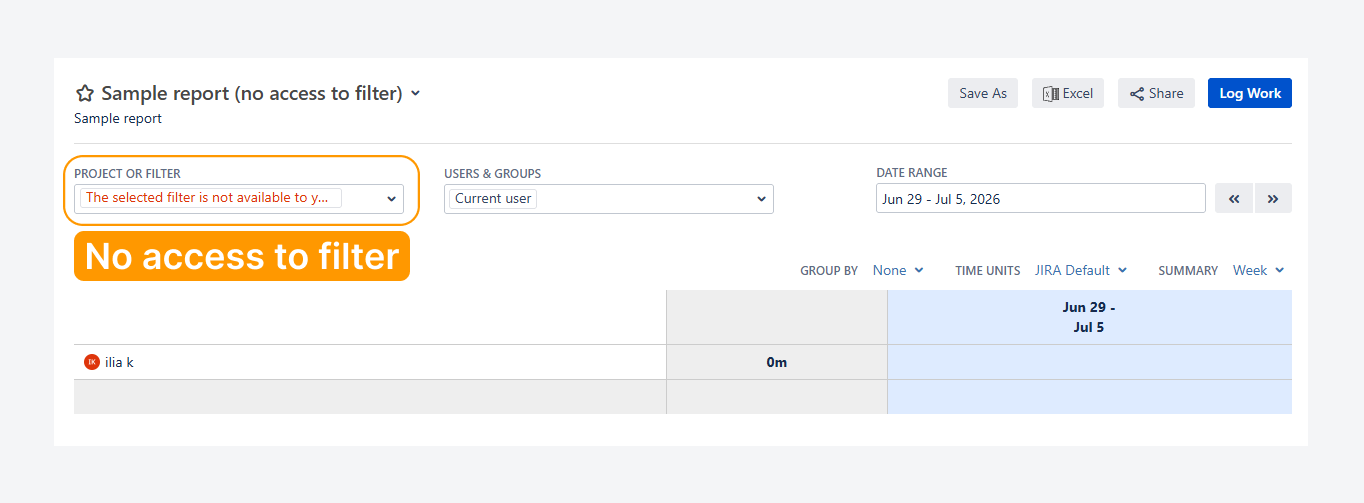
The screenshot above shows the error message that appears when you no longer have permission to access a filter.
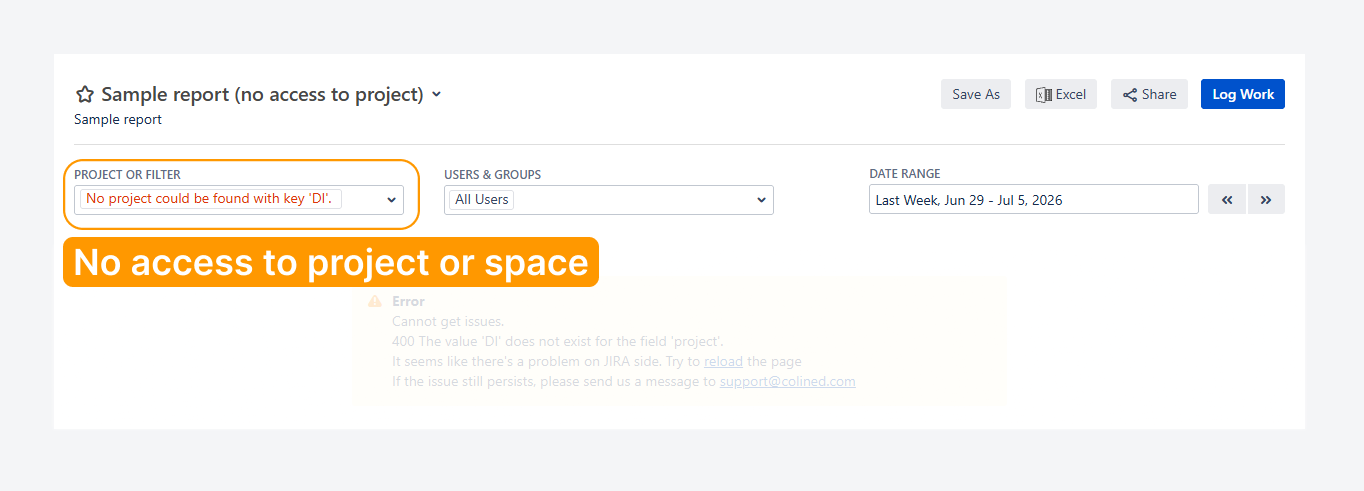
In comparison, the screenshot above shows another error message that appears when you no longer have permission to access a project.
These errors occurs because the app can access only data that you have permission to view. The app follows all permissions and third-party app restrictions configured in your Jira instance and cannot override them.
For example, you may have permission to open a report, but if you do not have access to its source, such as a filter or project, the report data cannot be displayed.
To resolve this work item:
-
If the report source is a filter, contact the report owner, report admin, or Jira admin to confirm who owns the filter and who can update its sharing permissions.
-
If the report source is a project, contact your Jira admin to verify that you have permission to view the project.
Troubleshooting
Can you lose access to a report?
Yes. You can lose access to a report, as shown in the screenshot below.
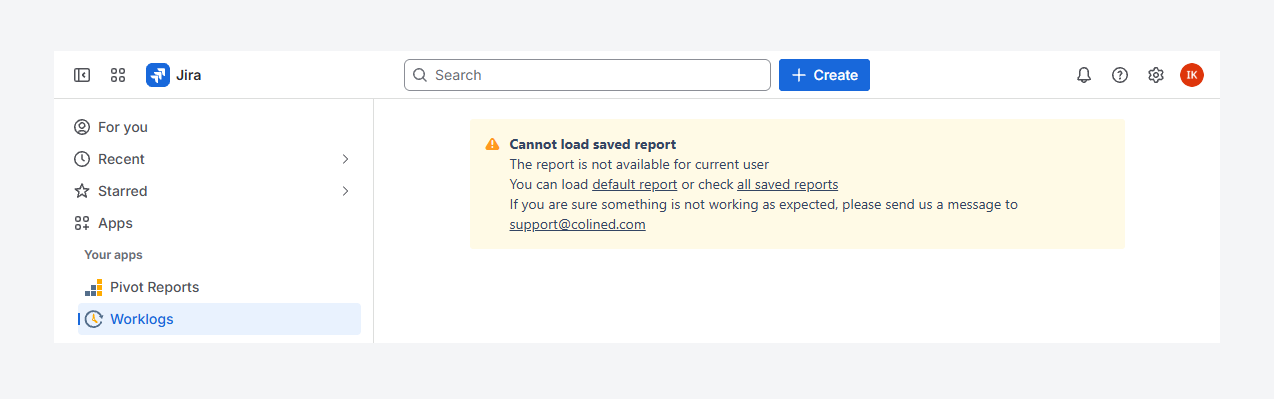
The error message appears when you try to open the URL of a report you no longer have permission to view, even if you previously had access.
Contact the report owner, another report admin, or a Jira administrator for assistance. Your access may have been removed by the report owner or another report admin.
Can a signed-out user access a report?
No.
Colined protects your data by not storing it on its servers and by blocking access to the app for signed-out users.
If you are signed out of Jira, you cannot edit reports or use the app’s features, such as the report list. You can only access exported reports to Excel.
You also cannot view embedded reports. Even if a Confluence space allows anonymous access, embedded reports display an error message until you sign in to Jira.
How can you tell if you’re logged out of Jira?
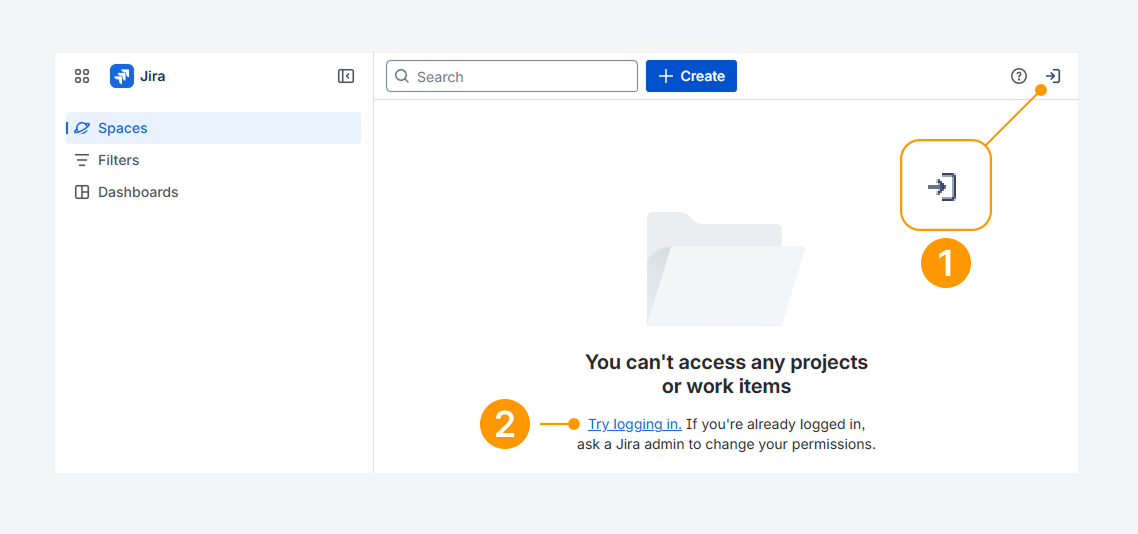
You can tell if you’re logged out of Jira by checking whether:
-
An arrow pointing right is shown the top navigation bar.
-
Spaces, Filters, or Dashboards load as blank pages.
These signs indicate your account is signed out.
Click the arrow or the Try logging in link to log back into your Jira account.
Can you account be logged out due to inactivity?
Yes. Your organization may set an idle session duration, which logs you out automatically after a period of inactivity, as explained in a related Atlassian article.
Also, check your browser’s site data settings, since closing the browser often signs users out.
Will Jira notify you before logging you out?
By default, Jira does not show a warning before ending your session. To change this behavior, see the related Atlassian article.
If you have questions or need assistance, contact our support team via email or service desk. Our team is available Monday through Friday (9:00 AM to 7:00 PM GMT+7) to help with technical challenges or discuss improvements.