
You may have reached this article after creating a report by following the steps in a related article and now want to change the issue hierarchy within that report.
This article explains why you might need to update a report’s issue hierarchy and how to access it from the report sidebar.
If you want to modify the report’s appearance instead of its hierarchy, see the related article. To update the report source, refer to the corresponding article. To define a common hierarchy for all reports, see the separate article.
Why you should you create a custom hierarchy?
A custom hierarchy lets you extend beyond Jira’s default structure (Epic → Story → Sub-task) without changing Jira settings.
By using issue links, such as Blocked by, you can build a hierarchy directly within a report and use it in the Issue Structure tab, or define a custom hierarchy and apply it across all reports. This approach lets you create relationships across multiple levels—from Sub-task up to Initiative, Theme, or any structure you define—even across multiple projects included in the report.
What is the difference between a Jira and a custom hierarchy?
-20260324-011306.png?cb=cebbad7ae4d0b6c0fa5ef9c3bddddf1e)
Jira hierarchy: Jira provides a default hierarchy based on standard issue types, such as Sub-task, Task, Bug, Story, and Epic. This built-in structure follows a fixed order and does not include higher levels like Themes or Initiatives.
Custom hierarchy: A custom hierarchy lets you define your own issue structure using existing issue links created in the Issue View. This allows you to extend the hierarchy beyond Epics to include levels such as Themes and Initiatives.
You can also create a custom hierarchy even if you don’t use standard issue types like Stories or Epics, without modifying your Jira settings.
Features and use cases
Use 'Blocked by' or another link to show a parent relationship
You can add links, such as as Blocked by, in the Issue View to represent a relationship with a parent item in your organization and display it using a custom hierarchy in a report. Other organizations may use different links, such as Belongs to, for the same purpose.
Make sure to extend the report source to include parent issue when they belong to another project. For example, an Initiative may act as a parent issue—through a relationship link—but exist in a different project than its Epic.
If the report source only includes the Epic and is not extended to include parent issues, the Initiative will not appear after enabling the custom hierarchy.
Follow these steps to verify relationship links, extend the report source, and configure a custom hierarchy:
-
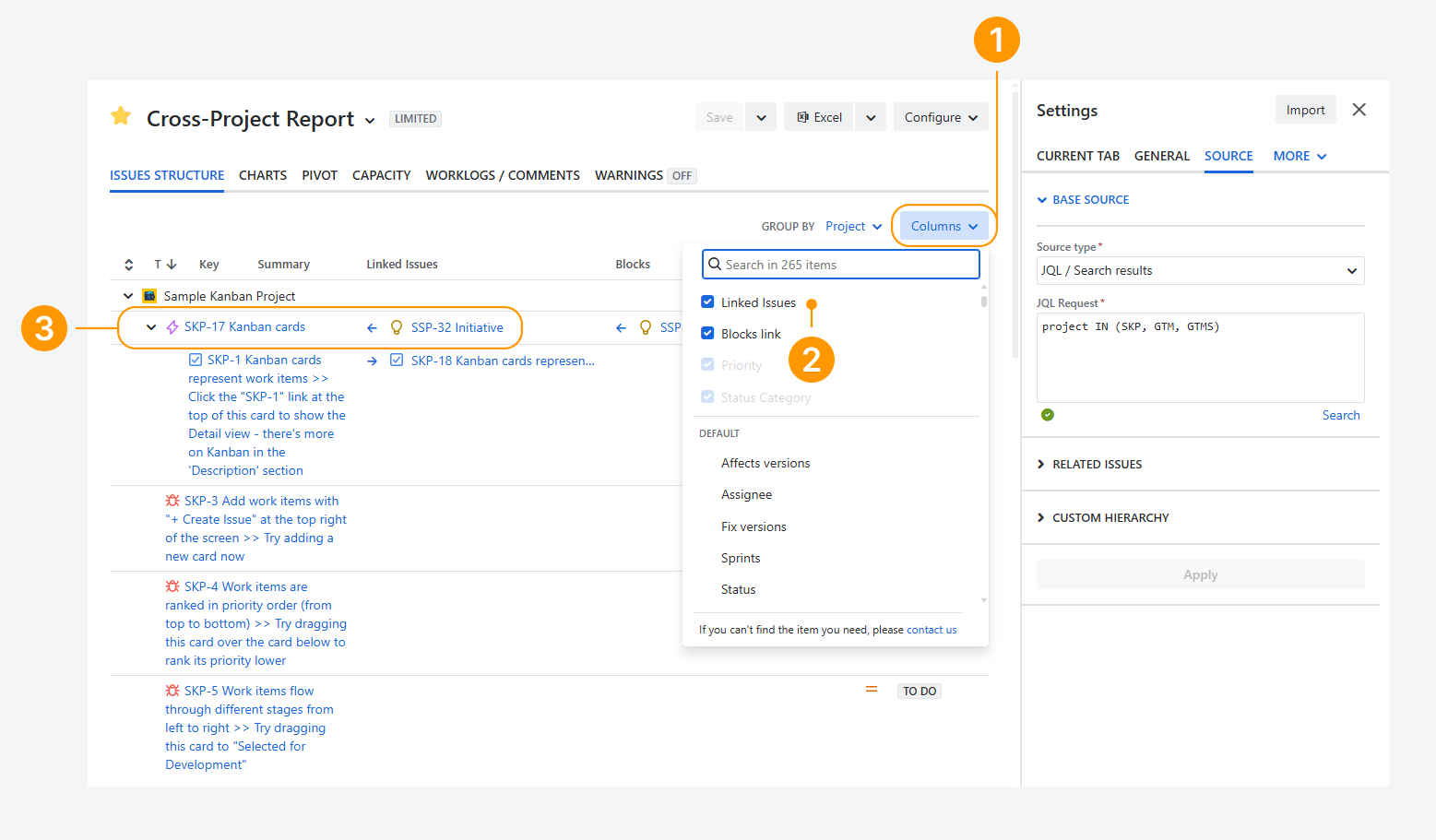
In this example, the report source references three projects using JQL. Click Columns.
-
Select or search for Linked Issues.
-
Identify the highest-level parent and determine the relationship type. In this example, Epic SKP-17 blocks Initiative SSP-32, which belongs to a project not included in the report source.
-
Enable Parent Issues to extend the report source.
-
Click Apply.
-20260325-174927.png?cb=1bccc549d224972b24b462c5584e66b3)
-
Click + Add Link Type.
-
Select a Parent Issue Type, Link Type, and Child Issue Types.
In this example, Initiative SSP-32 is blocked by Epic SKP-17. As a result, Initiative is the parent issue type and Epic is the child issue type.
-
Click Apply.
-20260325-181257.png?cb=8df1d9a687e876c5b139dee6f45ca07f)
After completing these steps, the parent relationship appears in the hierarchy, as shown in the screenshot below.
Note that Epic SKP-17 is grouped under the project associated with its parent Initiative as part of the custom hierarchy.
-20260325-182108.png?cb=e22887566ec9016b81ea3fe72b084a9c)
Use a common hierarchy across all reports
-20260325-160644.png?cb=cc029e86db857e2af1d8fd8c48b32fe0)
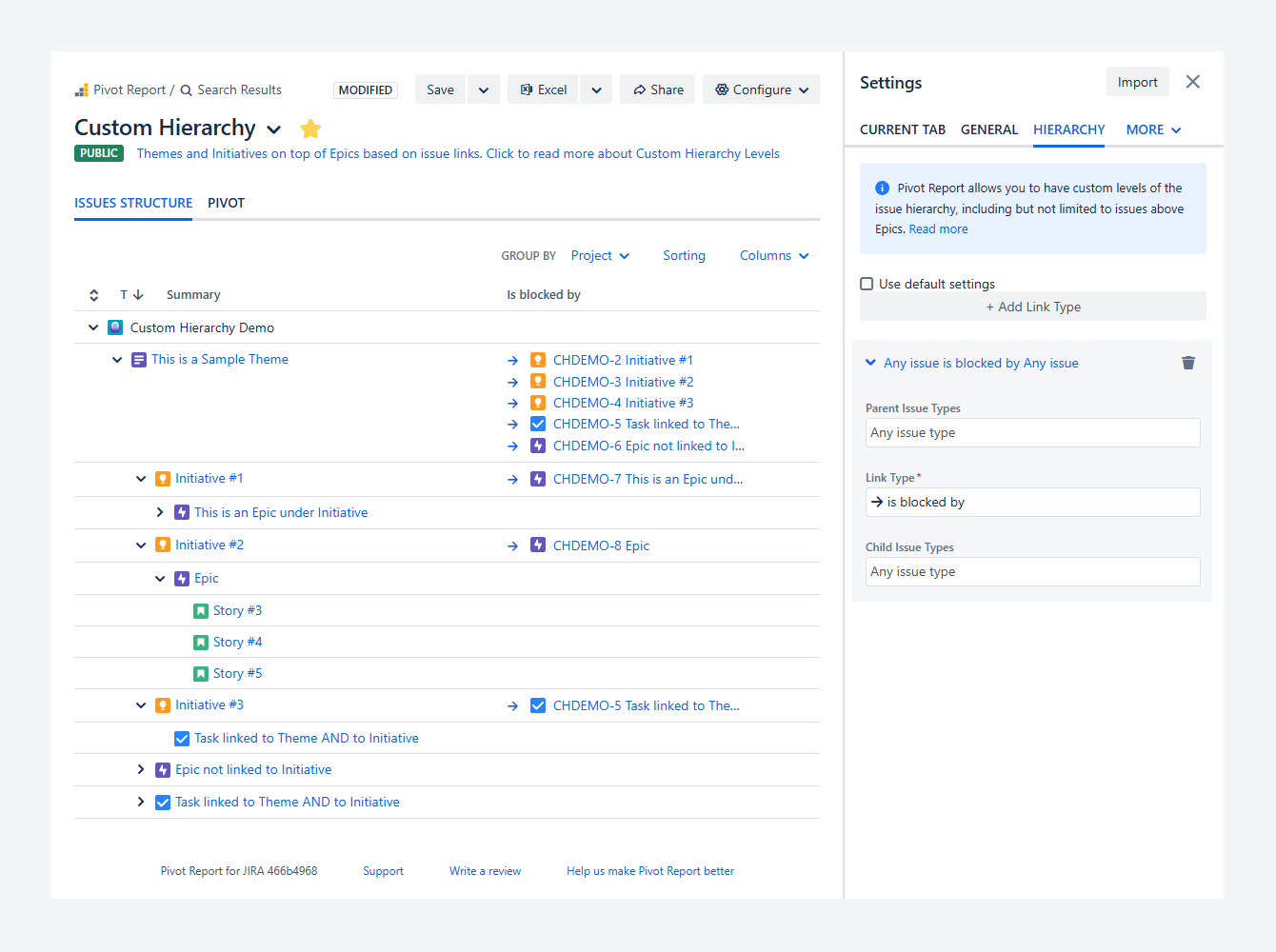
You can apply a shared hierarchy across all reports by selecting Use default settings in the report sidebar, as shown in the screenshot above.
A Jira admin can configure a custom hierarchy that is automatically applied to newly created reports or to any report where this option is selected. The steps to create this hierarchy are described in a related article.
How can you create custom hierarchy within a report?
The Hierarchy tab can be accessed from the report sidebar by following these steps:
-
Click Configure in the header section.
-
Select Hierarchy in the dropdown.
-
Select a Parent Issue type, Link Type, and Child Issue types.
-
Click Apply.
-20260319-181027.png?cb=4c0bfbd2ed5e3872dce73641e710ea13)
FAQ
How can you interpret the relationship links?
-20260324-033455.png?cb=0eb4f144c2afc71b723b0017fab3b1b2)
In the Issue View, an Epic is linked to an Initiative using a Blocks relationship. This means the Initiative is blocked by the Epic.
In the Issue Structure tab of a report, the Blocks column displays the Initiative. The arrow points toward the Epic, indicating that it is blocking the Initiative.
Can you override a common hierarchy in a report?
Yes. You can override the common hierarchy by disabling Use default settings in the report sidebar. In the screenshot above, this option is enabled.
Once disabled, the common hierarchy is copied into your custom hierarchy. You can remove these entries by clicking the bin icon or by editing each field individually (Parent Issue Type, Link Type, and Child Issue Types), as shown in the screenshot below.
-20260325-162533.png?cb=af399119045e2bd0b0ef5d72c726b19a)
Can you use a custom hierarchy to any deliverable type?
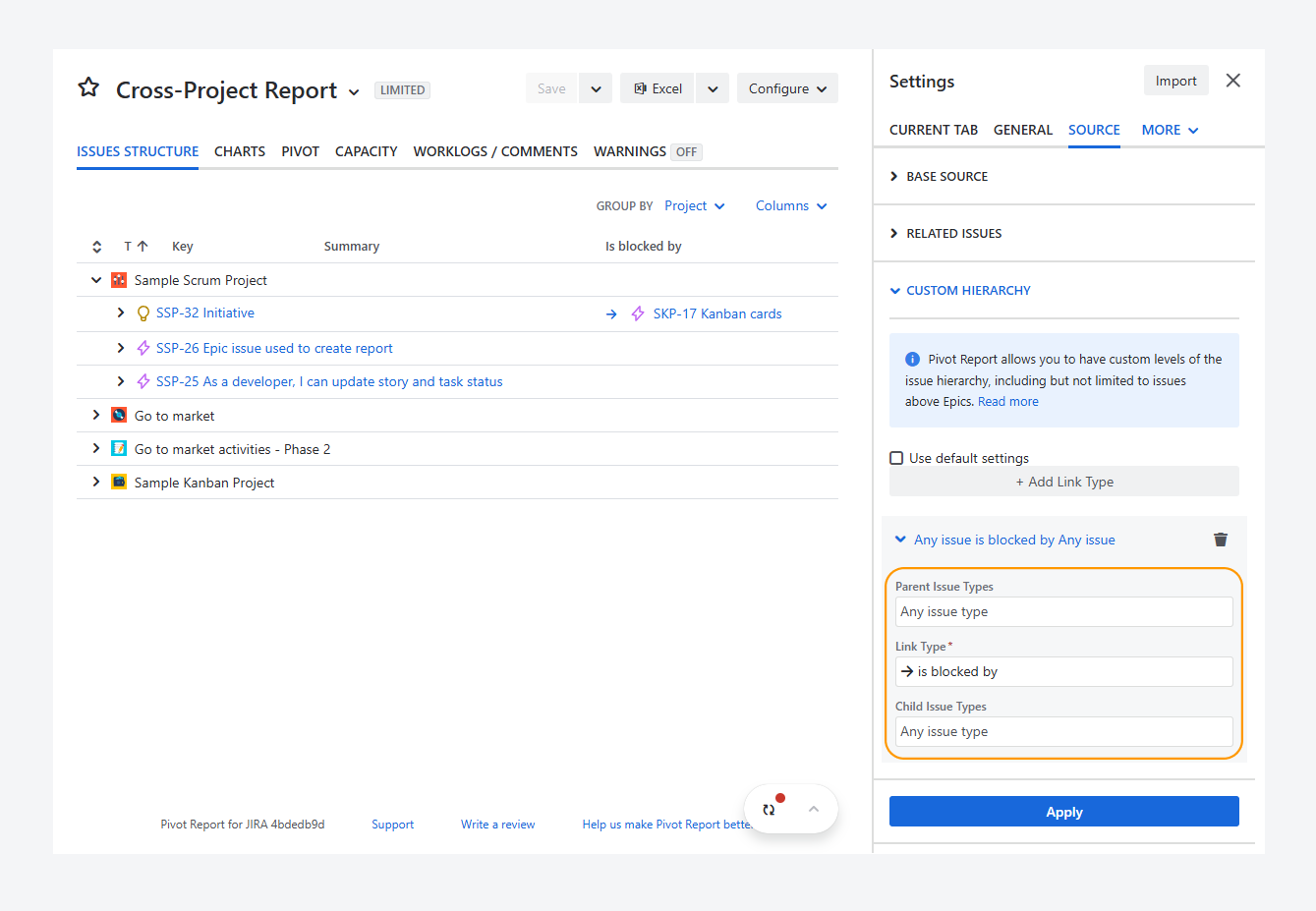
Yes. You can define a custom hierarchy for a specific issue type or apply it to all issue types, as shown in the screenshot above.
Leave the Parent issue types and Child issue types boxes empty to apply the hierarchy to any issue type. However, this may cause an issue to appear multiple times in the hierarchy.
Troubleshooting
Why is one your deliverables linked to multiples parents?
-20260319-205759.png?cb=e7c655fc8509ec7274018475182f0371)
An issue can appear under multiple parents in the hierarchy when using a custom hierarchy.
For example, a task can be linked to both a Theme and an Initiative. In this case, the issue may appear under both parents.
The task and its sub-tasks can appear under the Theme.
Only the task appears under the Initiative. The Initiative itself may also be linked under the same Theme.
Without using a custom hierarchy, the task and its sub-tasks would not appear under both a Theme and an Initiative.
To prevent an issue from appearing multiple times in the hierarchy, either unlink it from the Initiative or specify values in the Parent issue types and Child issue types fields.
Leaving these fields empty allows any issue type to be included in the relationship, as shown in the screenshot below.
-20260325-151858.png?cb=94f7342e1b7392c1c903f5c5b41153e7)
If you have questions or need assistance, contact our support team via email or service desk. Our team is available Monday through Friday (9:00 AM to 7:00 PM GMT+7) to help with technical challenges or discuss improvements.