
-20260717-180802.png?cb=2bb7f3069bf8cade7a328eb16cf21332)
You may have reached this article because you could not locate a calendar that you or another user previously created.
This article explains how to find and filter the list of saved calendars you have permission to access. It also explains how to create a new calendar.
How can you find a calendar?
Within a report
The General tab of the report sidebar includes a search box and a list of recent calendars to help you find a calendar. Follow these steps:
-
In the General tab, click the currently assigned calendar to open the calendar list.
-
Enter the calendar name in the search box. Matching results will appear highlighted as you type.
-20260717-193431.png?cb=318153382968e5bb864537587774513a)
Alternatively, click View all calendars to open the Manage Saved Pivot Calendars page, where you can browse all available calendars.
Within the Manage Pivot Calendars page
The Manage Pivot Calendars page helps you find calendars using a search box and three predefined filters.
To access this page from Jira’s top navigation bar:
-
Click Pivot Reports, and select Manage Reports.
-
Click the Calendars tab.
-20260717-205300.png?cb=132c7633e25aeae329ed60ec6a5599ad)
Features and use cases
Refine your search using predefined filters
-20260717-215842.png?cb=f891d5f178893587debcaf2f52b5fce6)
You can use this page to locate a calendar from the list, by searching for keywords, using predefined filters, or combining both methods.
These filters help you find calendars based on ownership or sharing permissions, such as calendars you own or calendars shared with everyone.
-
Enter keywords from the calendar name in the search bar.
-
Click one of the three predefined filters:
-
My Calendars: Shows calendars that you own.
-
Public Calendars: Shows calendars that all users in your organization can access within the Jira instance.
-
All Calendars: Shows a combined list of My Calendars and Public Calendars.
-
You can also locate a calendar by spotting the highlighted keywords in the search results.
Display calendars with the same name and tell them apart
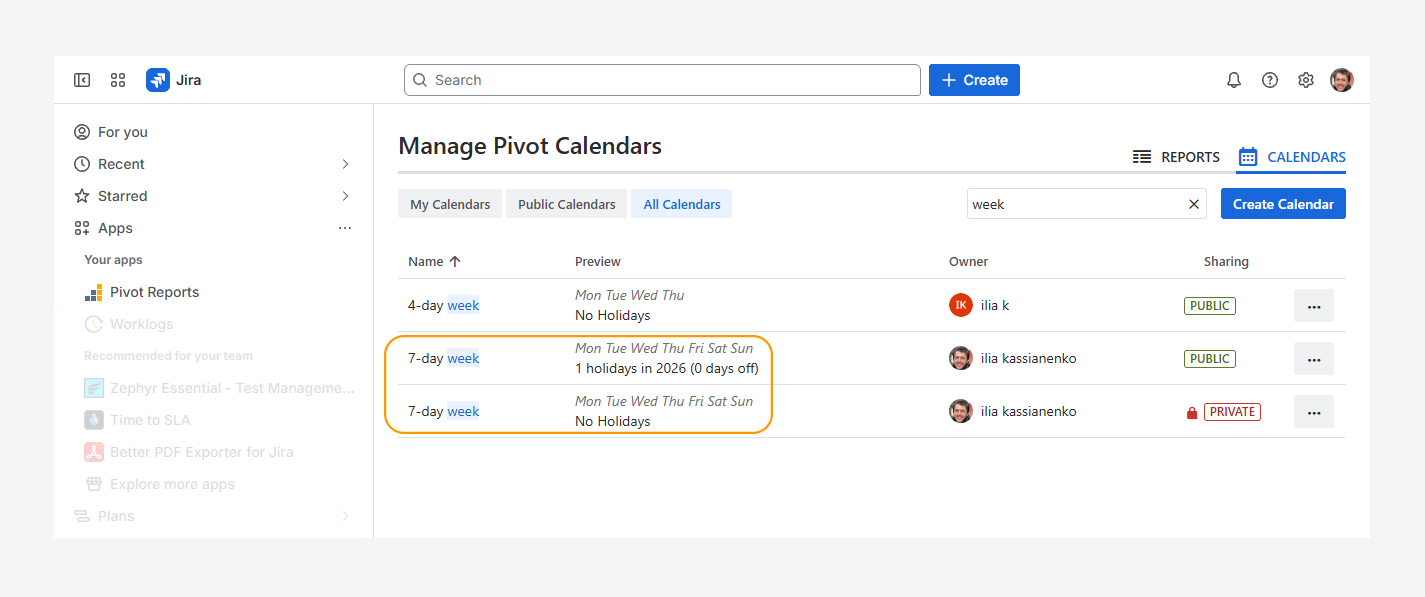
When searching for a saved calendar using the methods described in this article, you may find multiple calendars with the same name.
You can distinguish between them on the Manage Pivot Calendars page by reviewing the Preview and Owner columns.
For example, in the screenshot above, one calendar includes a civic holiday, while the other does not.
To avoid confusion, assign a unique name to each calendar when creating or copying it. This helps ensure that you select the correct calendar during your search.
How can you create a calendar?
You can use the Default calendar, create your own calendar, or make a copy of a calendar that you have access to.
Default calendar
You can view the Default calendar configuration by clicking the … menu next to it and selecting Configure.
The Default calendar is available to all users who have access to the app. It uses a Monday-to-Friday work week and does not include holidays.
-20260717-211650.png?cb=f3c74e943b0a631417cae01fe6c6fb9c)
Your calendar
You can create a new calendar or make a copy of an existing calendar by following these steps:
-
On the Manage Pivot Calendars page, click Create Calendar.
-20260717-212115.png?cb=5ddc4ecfd4e2d7140ac4b5b1af0414fa)
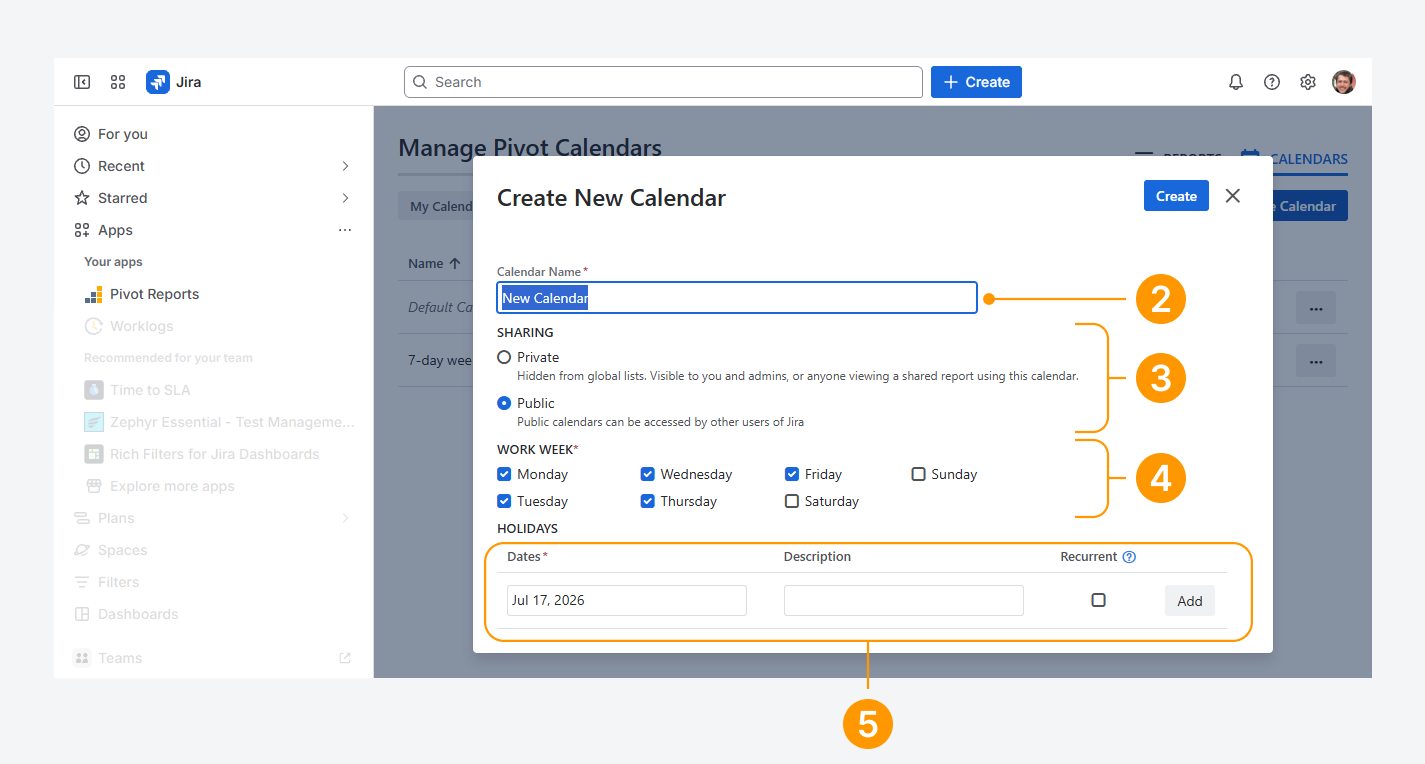
In the Create New Calendar pop-up:
-
Enter a name for the calendar.
-
Select a sharing type for the calendar.
-
Select the work week days.
For example, you can configure a four-day work week with longer shifts or a five-day work week with regular shifts.
-
Select a holiday date range, enter a description, and choose whether the holiday repeats annually.
For example, if your office is closed from December 24 to December 25 every year, select both dates in the range. If you select only December 25 as a single date, no additional days off will be included in the calendar.
-
Click Create.
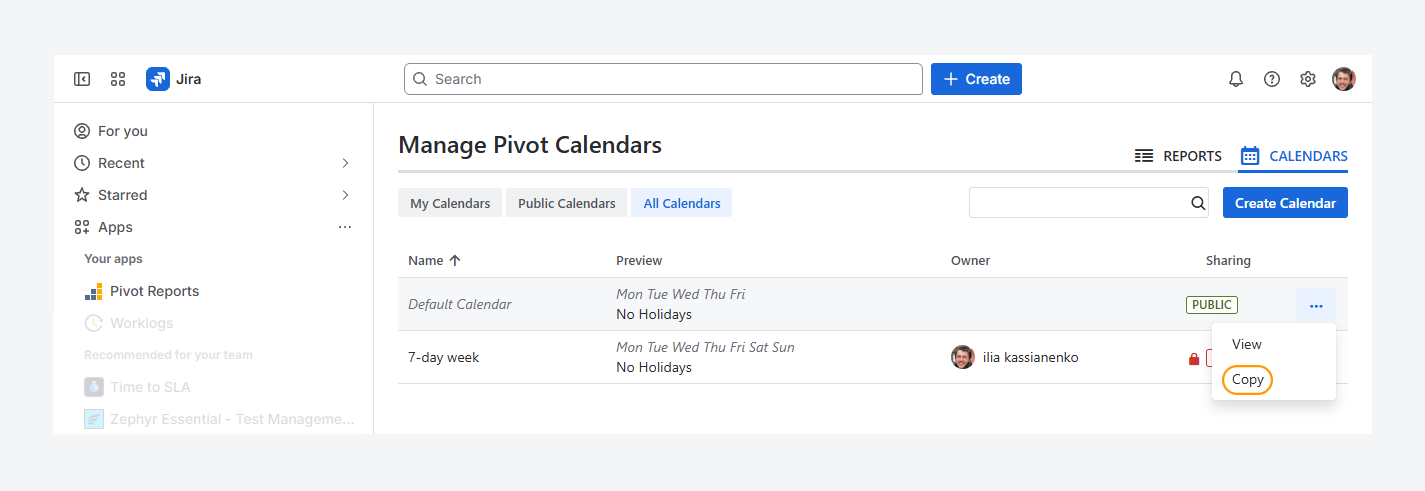
Copy a calendar
You can make a copy of the Default calendar, any Public calendar, or any calendar that you own by clicking the … menu next to it and selecting Configure.
How can you edit a calendar?
As a calendar owner, you can configure your Private and Public calendars from the Manage Pivot Calendars page.
-
Click the … menu next to a calendar and select Configure.
-20260717-185740.png?cb=e321483b4a75dd0918b691868915a771)
-
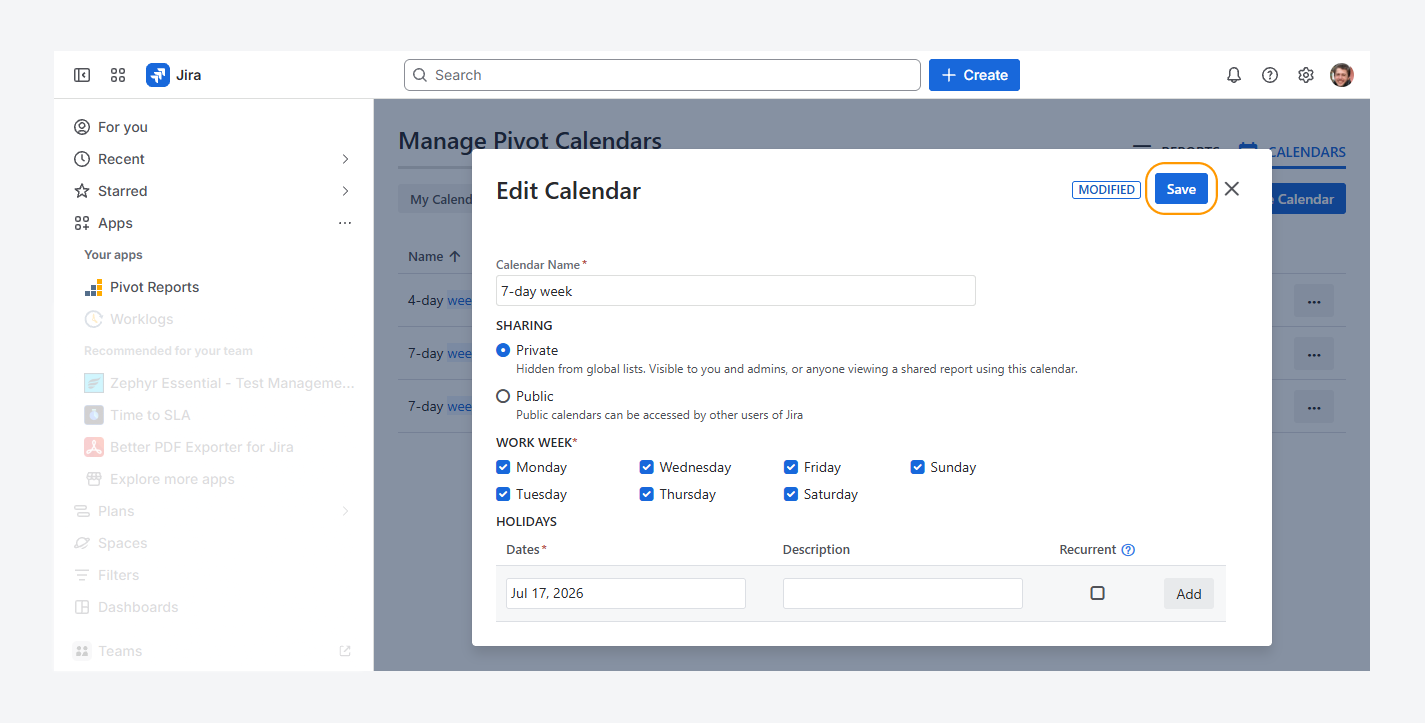
In the Edit Calendar pop-up, you can modify the calendar name, sharing type, work week days, holiday date range, holiday description, and whether holidays repeat annually.
-
After making your changes, click Save.
FAQ
Troubleshooting
Can a signed-out user access a report or a calendar?
No.
Colined protects your data by not storing it on its servers and by blocking access to the app for signed-out users.
If you are signed out of Jira, you cannot edit reports or use the app’s features, such as the report or calendar list. You can only access exported reports, including Excel files, HTML snapshots, and PDFs.
You also cannot view embedded reports. Even if a Confluence space allows anonymous access, embedded reports display an error message until you sign in to Jira.
How can you tell if you’re logged out of Jira?
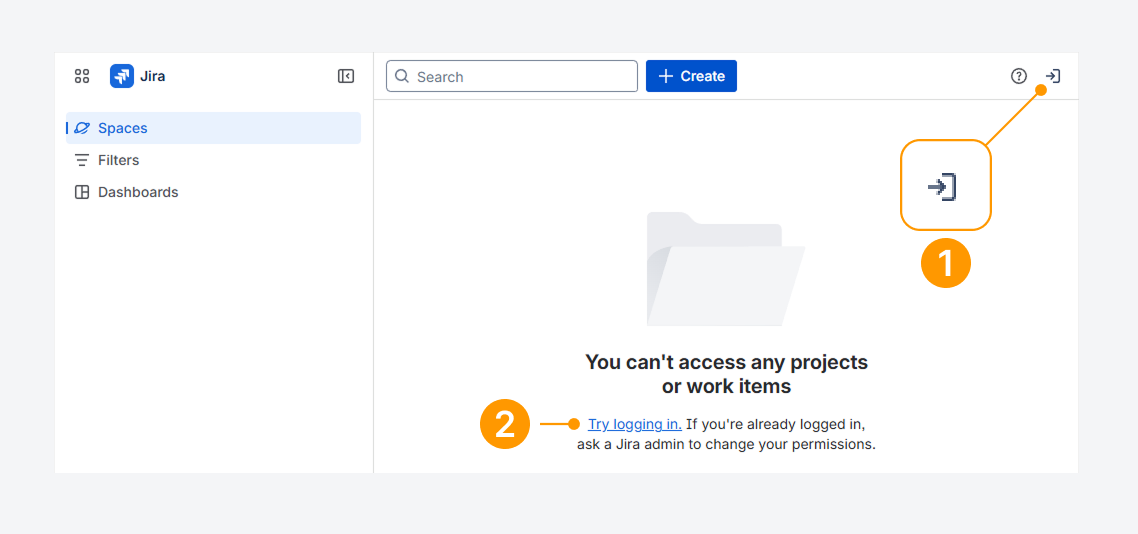
You can tell if you’re logged out of Jira by checking whether:
-
An arrow pointing right is shown the top navigation bar.
-
Projects, Filters, or Dashboards load as blank pages.
These signs indicate your account is signed out.
Click the arrow or the Try logging in link to log back into your Jira account.
Can you account be logged out due to inactivity?
Yes. Your organization may set an idle session duration, which logs you out automatically after a period of inactivity, as explained in a related Atlassian article.
Also, check your browser’s site data settings, since closing the browser often signs users out.
Will Jira notify you before logging you out?
By default, Jira does not show a warning before ending your session. To change this behavior, see the related Atlassian article.
Can you lose access to a report that points to a calendar you own?
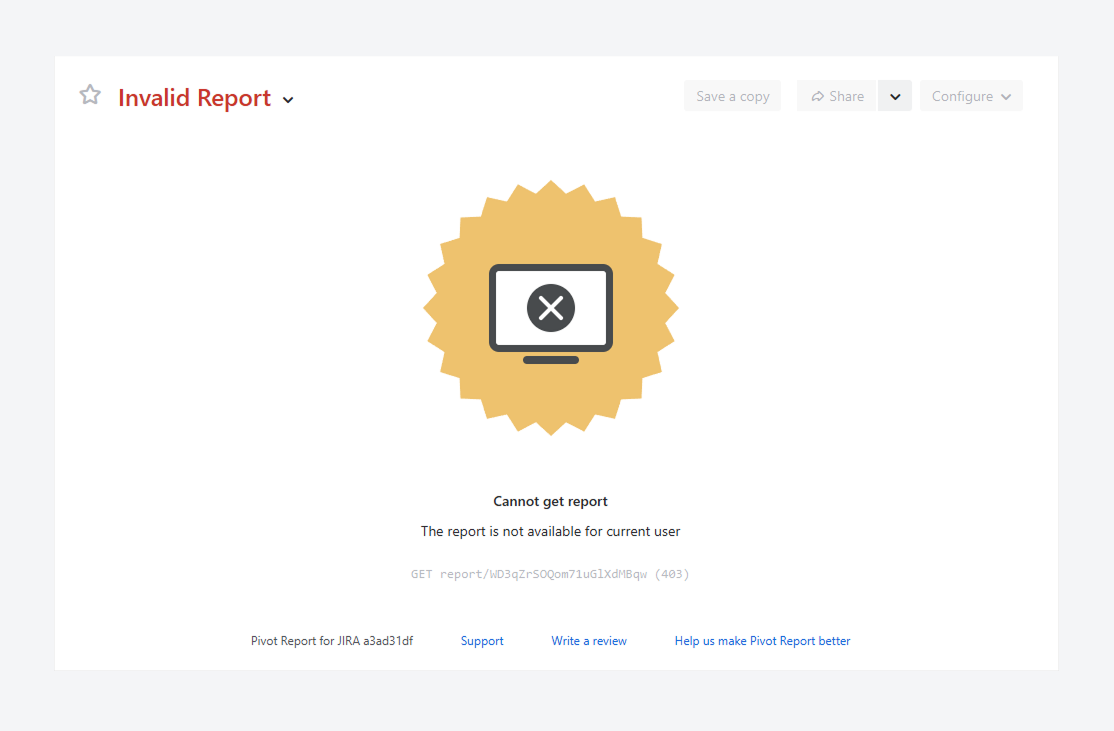
Yes. This error message above appears when you open the URL of a report that you no longer have permission to view, even if you previously had access or the report uses a calendar that you own.
After confirming that you are signed in by following the steps in the previous troubleshooting section:
-
Verify that you still have access to the report by following the steps in the related article.
-
If a different error message appears, verify that you have access to the report source by following the steps in the corresponding article.
-
If a blank page appears instead of an error message, verify that you have access to the app.
If you have questions or need assistance, contact our support team via email or service desk. Our team is available Monday through Friday (9:00 AM to 7:00 PM GMT+7) to help with technical challenges or discuss improvements.